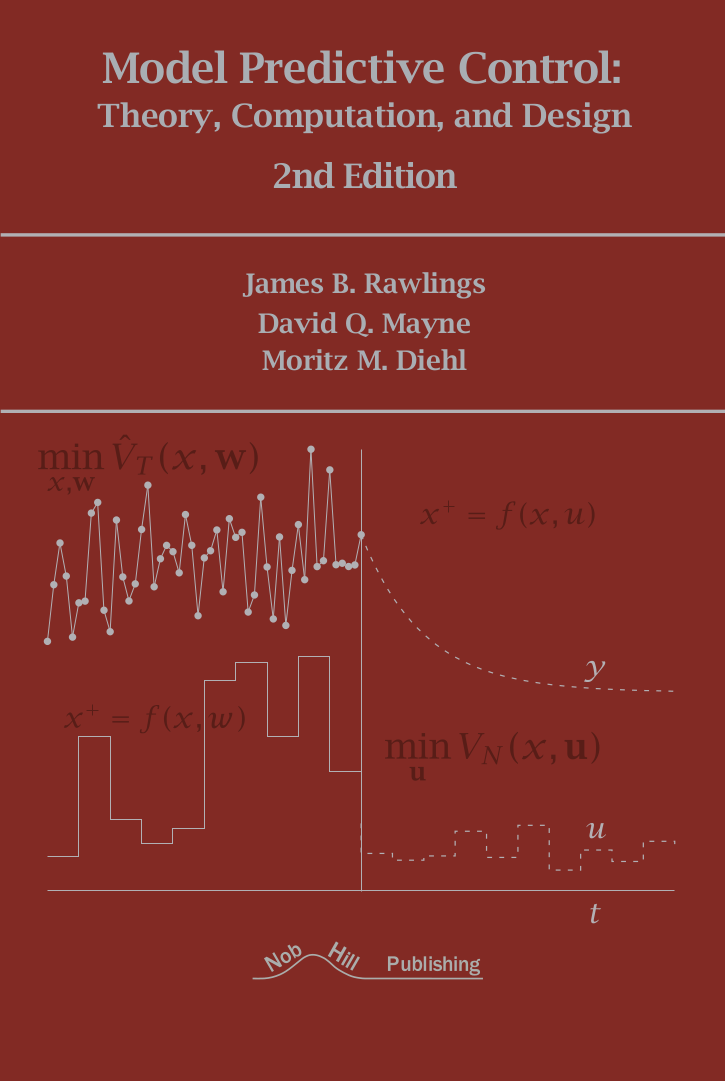
Nob Hill Publishing is pleased to announce the availability of the Second Edition of Model Predictive Control: Theory, Computation, and Design, by James B. Rawlings (University of California, Santa Barbara), David Q. Mayne (Imperial College London), and Moritz M. Diehl (University of Freiburg).
- Comprehensive and foundational treatment of the theory, computation, and design of model predictive control. More than 240 end-of-chapter exercises, 49 worked examples, 110 figures, and more than 300 assumptions, corollaries, definitions, lemmas, propositions, and theorems.
- New Chapter 8: Numerical Optimal Control — a comprehensive treatment of methods for the numerical solution of the MPC optimization problem, contributed by third coauthor Professor Moritz M. Diehl.
- New topics: economic MPC, MPC with discrete actuators, suboptimal MPC, stochastic MPC, new treatment of state estimation, distributed MPC of nonlinear systems, and new software for explicit MPC critical regions.
- Solution manual available to course instructors who adopt the text; contact orders@nobhillpublishing.com
- Software release based on the freely available CasADi language enabling solution of all numerical examples and exercises. Download from the course website.
- Sold in more than 50 countries on six continents.
Order through Amazon

770 pages • illustrated • paperback
ISBN 978-0-9759377-5-4
US$75 list • © 2026
Downloads & Resources
Endorsement
“This is a ‘tour de force’ in a field where the need for such a comprehensive user-friendly textbook has been felt for many years. While ideas and techniques of Model Predictive Control have been popular in both industry and academia for more than two decades, only now will practicing engineers, engineering students and instructors be able to use a single volume as a source for both practical algorithms and their analytical foundations. The authors’ ability to harmonize the pedagogical accessibility of the text with rigorous proofs of the main results is most impressive. The presentation is made vivid with an extremely rich collection of examples and exercises. I consider this work one of the two or three most successful works in the broad field of control theory.”— Professor Petar Kokotovic, Dept. of Electrical & Computer Engineering, University of California, Santa Barbara (2009)